Yaak is a local-only desktop API client with 100% of its features open source under the MIT license, yet it just crossed $5k MRR. 🤯
So what are people paying for? Commercial use of the prebuilt binaries. You can build the app yourself for free or pay to use the official downloads for work. Personal use is free either way.
I wasn’t sure this would work when I chose it, but it’s now earning enough to keep me working on Yaak full-time without putting features behind a paywall or running a paid cloud service. Here’s how I ended up here.
When I quit my job in 2024 to go full-time on Yaak, it didn’t yet have a business model. It barely had any users. I wanted to make it as open and accessible as possible, so open-source donations seemed like a good fit.
I reached out to a few companies for sponsorship and they all replied with some variation of “no thanks, why don’t you just charge for cloud sync or pro features?”
Those responses, combined with Blender being the only successful donation-funded desktop app I could think of, made me reconsider.
I’d already tried paid cloud features with Insomnia, the API client I built before Yaak. But maintaining and debugging encrypted cloud sync was a primary contributor to my burnout and the eventual sale of the company.
Yaak is the spiritual successor to Insomnia, so this time I wanted to try something that would be more sustainable for both me and the user. Keeping data local is a big part of that, so a paid cloud addon was off the table too.
Open core offered an obvious way to charge: open-source the free features and keep some features closed, behind a paywall.
But I wanted companies to be able to audit the entire app. I also didn’t want an incentive to move more and more features behind a paywall if the business didn’t grow. That felt like a path to enshittification.
Charging for commercial use felt like a reasonable compromise: people using Yaak for hobbies could use it for free, while people using it for paid work would purchase a license.
At the time, closed-source apps like Obsidian and OrbStack had success with this model, but I also wanted Yaak to be fully open source. So I did some research and found projects that license their prebuilt binaries separately from the source code. That seemed like a good fit.
I still had my doubts about whether it would work for Yaak. Anyone could build it themselves and never pay me anything. But I had a hunch that larger companies would rather pay for official builds and automatic updates than maintain their own, especially when purchasing a license also keeps their legal team happy. So if I could just get in the door to those companies, it should work. 🙈
The license applies to the prebuilt installers on Yaak’s download page, as well as the updates served to those installations. Personal use, including every feature, is free. Using those builds for paid work requires a license after a 30-day trial.
The MIT source has no such requirement. You can always build and run it yourself, for free.
| Build from source | Official downloads | |
|---|---|---|
| Personal use | Free | Free |
| Commercial use | Free | License required after 30 days |
| Features | All | All |
| Updates | Build yourself | Automatic |
To provide extra incentive without paywalling features, a license also includes direct email support and higher priority for anything posted or voted on in the feedback portal. The app is the exact same for licensed and non-licensed users.
The biggest question I get from people is how is commercial use enforced?
The app doesn’t lock you out when the trial ends. I can’t reliably tell whether someone is using Yaak for paid work, so in practice I rely on users to follow the license terms.
Sound familiar? It’s surprisingly close to the donation model I initially considered. The difference is that commercial users of the official builds are required to pay, rather than just encouraged to support the project.
I still want Yaak to be accessible to people with different budgets and circumstances. Requiring a commercial license doesn’t have to mean an annual subscription at the same price for everyone.
Can’t afford commercial use?
Build and run the source for free, even for paid work.
In a country where commercial use is too expensive?
Use a purchasing power parity discount of up to 60% off.
Don’t like subscriptions?
Cancel and keep using your last covered version forever with the perpetual fallback license, or purchase a lifetime license at around 5x the annual price.
There are currently 37 business and 421 individual subscriptions. Businesses contribute $3,247 MRR, compared with $1,699 from individuals.
Despite making up a small share of subscriptions, businesses account for two thirds of recurring revenue. The largest business account is around 80 seats, so my hunch about companies paying seems to have held up so far.
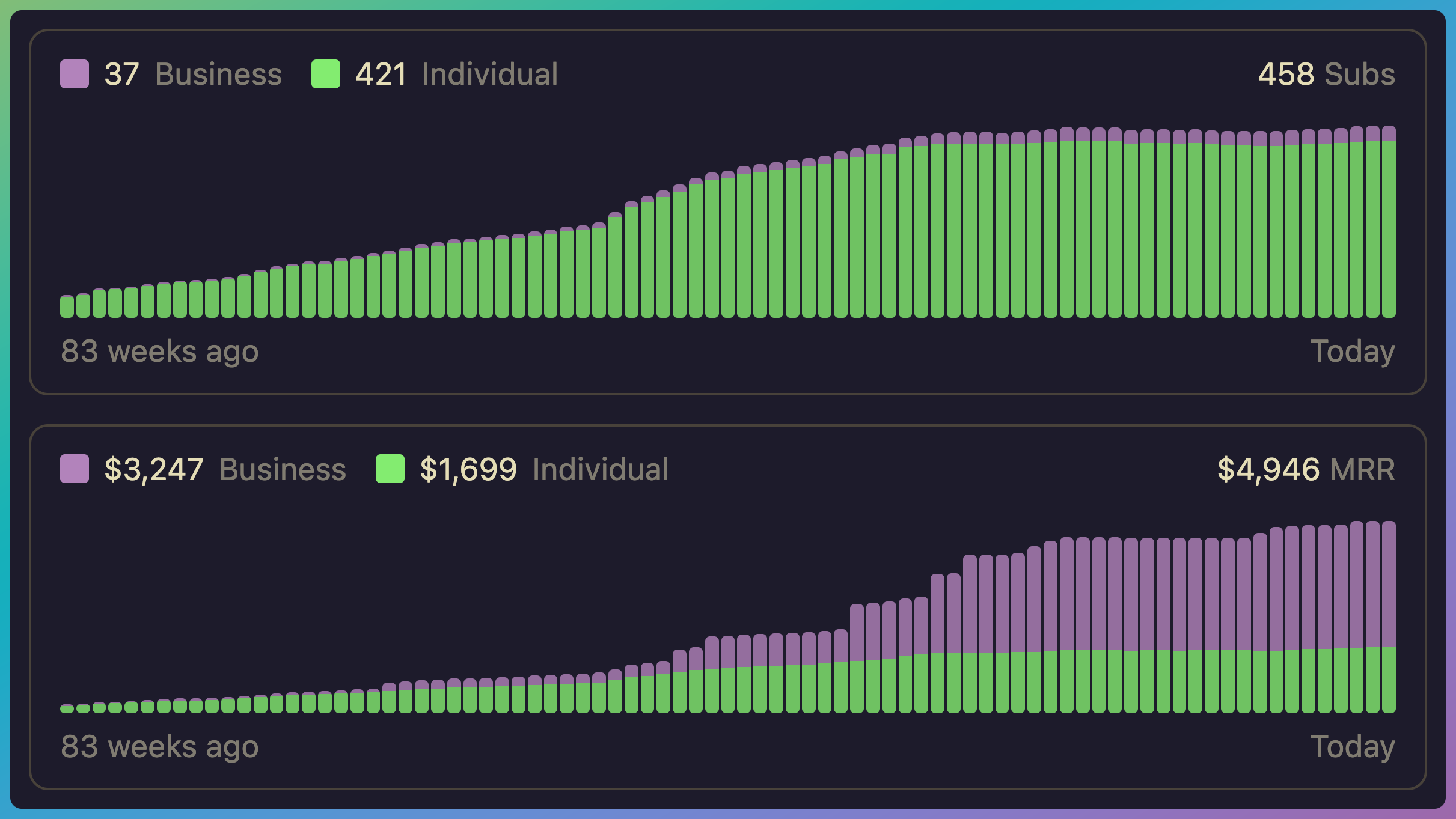
Together, that’s roughly $5k MRR, with additional revenue from lifetime sales. This combined income is enough to cover Yaak’s operating costs and my basic living expenses!
The biggest downside of charging for commercial use is getting Yaak into companies in the first place. A developer may want to use it, but their company must first approve the purchase.
For one or two devs, the company may not want to put in the procurement effort, so they end up using a free alternative. The 30-day trial doesn’t remove that hurdle.
Building from source is an option, but now someone has to take responsibility for building and updating the app.
99% of monthly active users don’t pay for Yaak. Personal use is free by design, and I don’t know how many people use the official builds commercially without paying.
Even someone intending to buy a license might never get around to it. Paying doesn’t unlock any features, and they never encounter a point where they have to stop working and purchase a license to continue.
Yaak runs locally, so those users don’t create hosting costs for me. But the lack of urgency is still a real downside when trying to make a living from it.
One large company reached out with questions on migrating roughly 800 users from Postman to Yaak. I initially thought it was a sales inquiry, but they ended up forking the repo, making changes for their workflow, and running their own version. For free.
I’d hoped it would become a huge sale, but this is an option fully supported by the license. Keeping Yaak under MIT means giving companies that freedom. And perhaps those users will bring Yaak to other friends and colleagues as well.
Since launching this model, projects like Cozy Watch have taken inspiration from Yaak and adopted it too. I’d love to see more examples of how it works for other projects.
After two years of living off savings, my bank balance is finally no longer shrinking each month. I can keep working on Yaak full-time, and every feature is still open source. That’s what I wanted to make possible when I started.
Postman removed free team collaboration in March 2026, and legacy plans convert to the new pricing at renewal. What that costs, what your options are, and how to move your collections.
A year ago I had just launched Yaak’s commercial-use license and was sitting at $160 MRR. It was a gamble to choose a…
Yaak is a local-first API client that focuses on security, ease of use, and collaboration (using Git). Thousands of…